3 June 2026 · 11 min read
How to Identify Genuine Mid-Century Furniture
How to tell authentic mid-century modern pieces from reproductions — construction, materials, makers' marks and the wear patterns to look for.
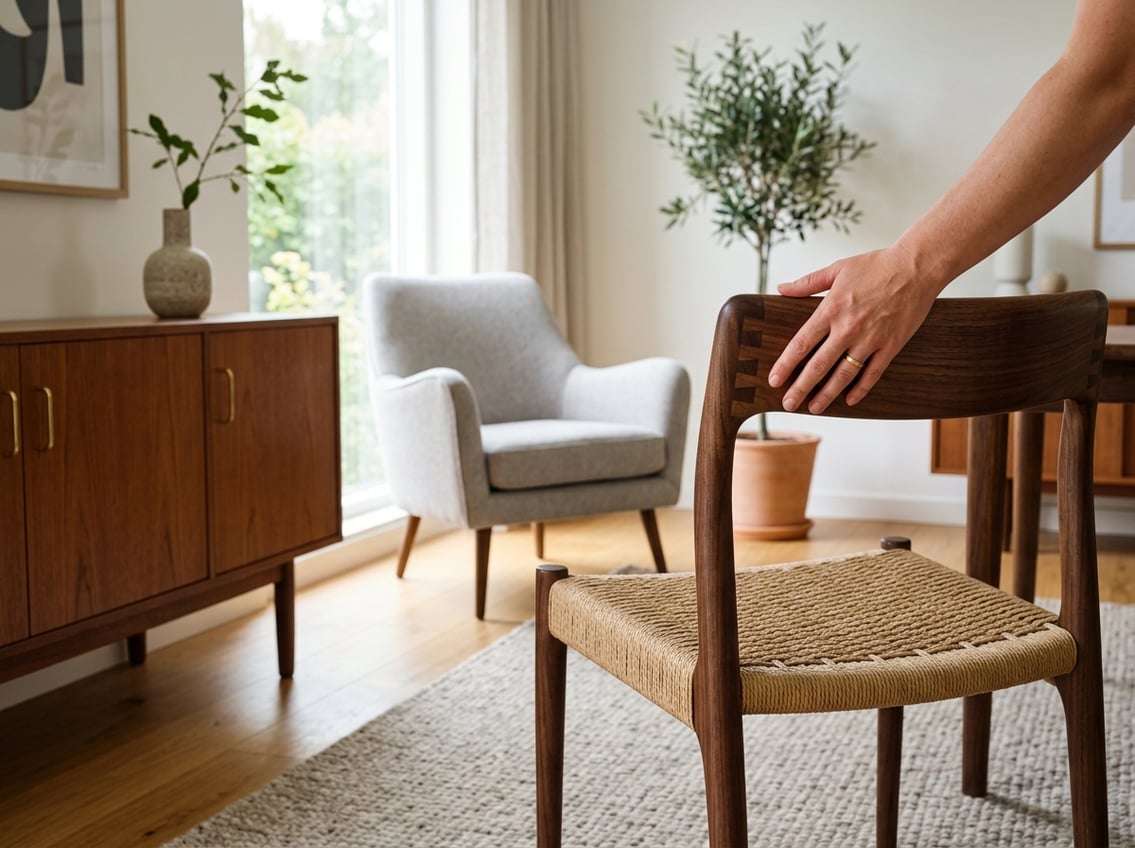
The mid-century modern furniture market has exploded in recent years, making it harder than ever to separate authentic vintage pieces from modern reproductions.
With prices for genuine MCM furniture reaching record highs, knowing how to spot the real thing can save you thousands and protect you from disappointing purchases.
Authentic mid-century furniture can be identified through specific construction methods, period-correct materials, makers' marks, and wear patterns that genuine vintage pieces develop over decades.
Understanding these key indicators helps you make smarter decisions whether you're shopping at estate sales, antique dealers, or online marketplaces.
This guide will help you examine construction details, recognize quality materials from the mid-century period, identify renowned designers and manufacturers, and spot the red flags that signal reproductions.
You'll soon have practical skills to evaluate any piece with confidence.
Defining Features of Authentic Mid-Century Furniture
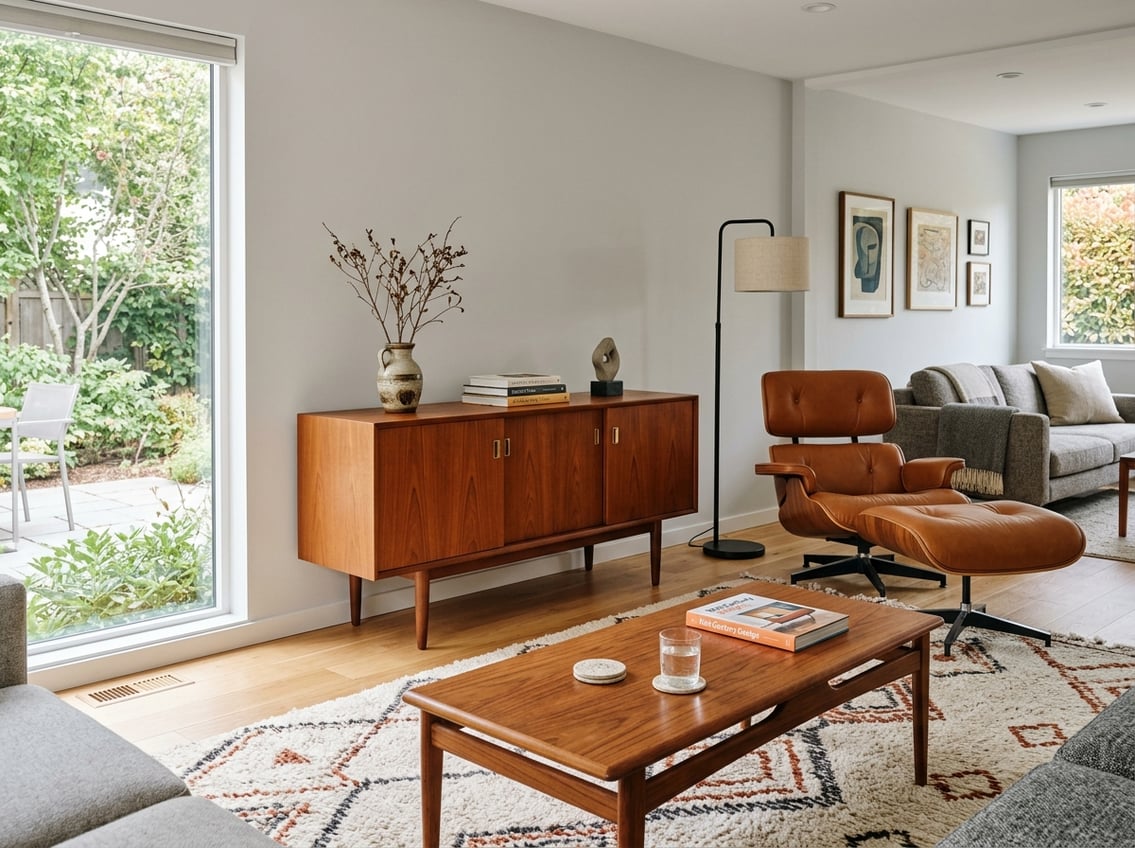
Authentic mid-century furniture stands out with three distinctive visual characteristics that set it apart from other design periods.
The focus on simplicity, natural forms, and elegant proportions creates a timeless look that's still instantly recognizable today.
Recognising Clean Lines and Minimal Ornamentation
Clean lines are the foundation of mid-century modern design.
You'll notice straight edges and geometric shapes dominate the silhouettes, with little to no extra decoration.
Instead of ornate carvings or decorative mouldings, designers let the natural beauty of materials and the purity of form shine.
Every element serves a purpose—nothing exists just for show.
When checking out a piece, look for surfaces without carved details or added trim.
Hardware should be simple and blend into the design, with handles often flush with drawer fronts and neat, visible joinery.
This honest approach reflects the movement’s belief that good design doesn’t need to hide behind fancy details.
The Role of Organic Shapes and Curves
While clean lines provide structure, organic shapes and curves bring warmth to mid-century furniture.
You'll spot gentle curves in seat backs, armrests, and tabletops that mimic natural forms.
These curves make pieces more comfortable and ergonomic.
Chair backs often have sculptural shapes that support your spine, and table edges might feature soft rounded profiles instead of sharp corners.
The magic is in the balance—a chair might pair straight legs with a curved seat shell, or a sideboard could mix geometric cabinet fronts with rounded drawer pulls.
This blend of geometric precision and natural forms keeps things interesting without adding clutter.
Tapered Legs and Distinct Silhouettes
Tapered legs are one of the most recognizable features of authentic mid-century furniture.
These legs start thicker at the top and narrow as they reach the floor.
You'll see different styles:
- Straight tapered – legs narrow evenly on all sides
- Splayed – legs angle outward while tapering
- Turned – shaped on a lathe with gradual tapering
These legs give mid-century furniture its signature lightness, making pieces look like they're floating above the floor.
This visual weightlessness fit perfectly with the open-plan living spaces of the era, helping rooms feel airy and uncluttered.
Understanding Materials and Construction Methods
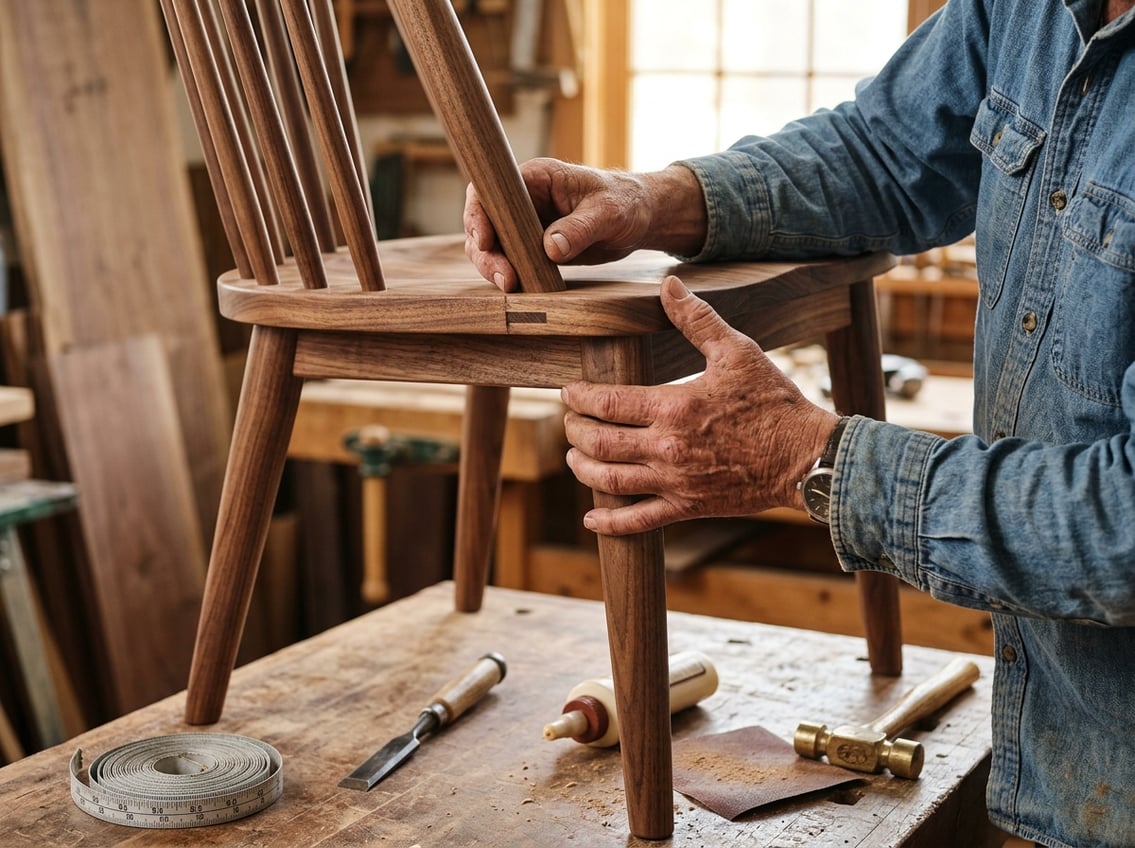
Authentic mid-century furniture shows its quality through specific materials and solid construction techniques.
The wood types, joinery, and original finishes can tell you if a piece is truly from the era or just a modern copy.
Solid Wood Construction Versus Veneers
Mid-century designers used both solid wood and veneers, depending on the part of the furniture.
Solid wood was used for structural elements like legs, stretchers, and frames.
Veneer wasn’t just a shortcut—it was a thoughtful design choice.
High-quality Danish teak furniture often featured matched veneer over stable plywood cores, preventing warping and showing off dramatic grain patterns.
The trick is to spot quality veneer work.
Authentic pieces have bookmatched veneer with consistent thickness and smooth, expertly finished edges.
Run your hand along the sides—they should feel smooth and intentional, not rough or unfinished.
Bent plywood and molded plywood are another story.
These materials used thin wood layers glued and shaped under pressure, creating strong, sculptural forms unique to the period.
Quality Materials and Original Finishes
Teak is the superstar of Scandinavian mid-century pieces, loved for its natural oils and warm color.
Over time, real teak develops a unique patina, sometimes fading to silver-grey with light exposure.
Walnut was a favourite for American designers, known for its rich, dark tones.
Original finishes varied.
Danish furniture often had oil or wax finishes, while American pieces leaned toward lacquer or shellac for more protection.
You can spot original finishes by their wear patterns.
High-contact areas like armrests will show gentle wear, while hidden spots keep more finish.
The patina should look natural, not artificially distressed, and under angled light, you might notice subtle spray patterns.
Joinery Techniques: Dovetails, Mortise and Tenon
Traditional joinery separates quality mid-century furniture from mass-produced copies.
Dovetail joints are common in drawers, with interlocking wedge-shaped pins and tails.
Hand-cut dovetails have slight irregularities, while machine-cut ones are perfectly uniform.
Mortise and tenon joints connect bigger structural parts.
The tenon fits snugly into a hole (the mortise) in another piece, and these should be tight with no gaps.
Danish makers were known for finger joints—rectangular projections that interlock at corners.
Look for these inside drawers, under seats, and along frames.
Authentic pieces use very few metal fasteners, relying on well-made wood joints reinforced with glue.
Key Designers and Renowned Manufacturers
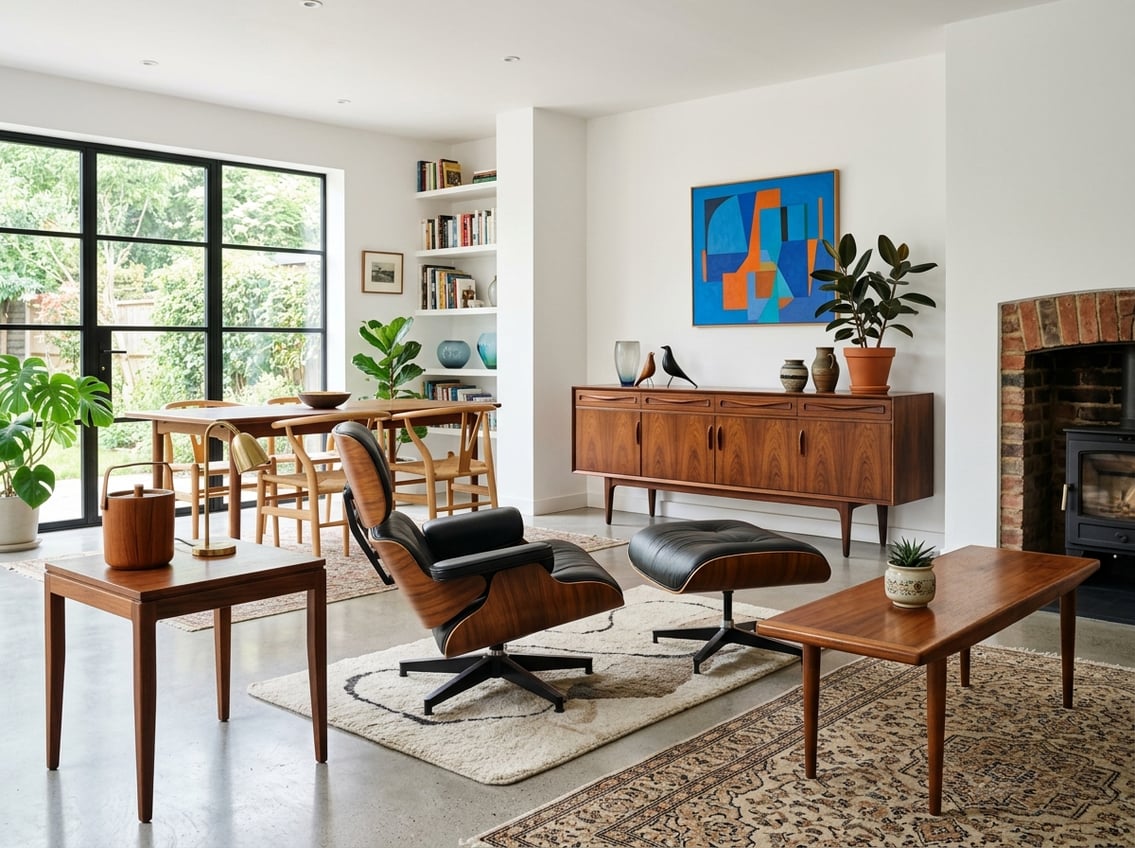
Getting to know the big names in mid-century design helps you spot genuine pieces.
Each designer had a unique style, and manufacturers used specific marks and methods that make authentication easier.
Iconic Designers: Eames, Hans Wegner, and More
Charles and Ray Eames created some of the most iconic furniture ever.
Their partnership with Herman Miller brought us the famous Eames Lounge Chair, molded plywood chairs, and fiberglass shell chairs.
Their work is known for organic shapes, innovative materials, and a focus on comfort.
Hans Wegner was a master craftsman, designing over 500 chairs in his career.
His Wishbone Chair (CH24) and The Chair are classics, known for seamless joinery and sculptural forms.
Arne Jacobsen designed the Egg Chair and Swan Chair, both for Fritz Hansen.
George Nelson, as design director at Herman Miller, created the Marshmallow Sofa and Ball Clock.
Florence Knoll changed office furniture with her clean-lined, functional designs.
Major Manufacturers: Herman Miller, Knoll, and Heywood-Wakefield
Herman Miller of Zeeland, Michigan is a huge name in mid-century modern, thanks to collaborations with the Eames office, George Nelson, and Isamu Noguchi.
Early pieces from the 1940s and 1950s have round metal medallions or foil labels, while later ones use embossed or plastic labels.
Knoll International produced designs by Eero Saarinen, Harry Bertoia, and Mies van der Rohe.
Early Knoll pieces have embossed or bowtie-shaped labels, with later versions sporting orange and white labels with the "K" logo.
Their upholstery and finishing are always top-notch.
Heywood-Wakefield made mid-century modern furniture accessible to American families, using blonde birch and streamlined shapes.
Look for stamped or branded marks on drawers and chair frames.
Identifying Signature Pieces and Makers' Marks
Authentic manufacturers used specific labels and marks that changed over the years.
Check the underside of seats, inside drawers, and under tabletops for stamps, medallions, or paper labels.
Herman Miller pieces might show round metal tags, embossed marks, or plastic labels depending on the year.
Common places to look for maker’s marks:
- Under chair seats and table tops
- Inside or under drawers
- On the back of cabinets
- Stamped into legs or stretchers
Knoll's bowtie-shaped and orange-and-white stickers help confirm authenticity.
Fritz Hansen stamps marks on chair frames, and Carl Hansen & Søn stamps marks inside joints.
Original hardware can also be a clue—Herman Miller Eames chairs had specific shock mounts that changed over time.
Keep in mind that makers' marks can be faked, so always check construction quality, wood type, and hardware along with any labels.
Authentication Techniques and Identifying Reproductions
Spotting authentic mid-century pieces versus reproductions means looking at labels, understanding the difference between permitted and unauthorised copies, and checking for later work that might affect value.
Examining Labels, Stamps, and Production Dates
Authentic mid-century modern furniture usually has maker’s marks that changed over time.
Herman Miller pieces from the 1940s-1950s used round metal medallions or foil labels, with later ones showing embossed or plastic labels.
Knoll International labels evolved from embossed or bowtie-shaped to orange and white versions with the "K" logo.
Fritz Hansen marks also changed, from simple stamps to more detailed labels.
Production dates are key.
The Eames Lounge Chair debuted in 1956, so any piece claiming to be older is likely not genuine.
Original hardware can help date a piece, since things like shock mounts changed over the years.
Check under seats, inside joints, and underneath tables for marks.
Carl Hansen & Søn pieces have stamped marks in hidden spots. G-Plan furniture uses circular brass medallions or paper labels.
No label doesn’t always mean a piece is fake—labels can fall off or wear away with time.
Spotting Unlicensed and Licensed Reproductions
Licensed reproductions are copies made with permission from the original manufacturer or rights holder. Contemporary examples can have their own collector value, but they should be described clearly rather than presented as period originals.
They feature current labels and modern materials that differ from vintage originals. Unlicensed reproductions and knock-offs flood online marketplaces.
These copies often use inferior materials—teak veneer over cheap substrates instead of solid teak, or substitute woods like afrormosia. Examine the quality of joinery and hardware.
Reproductions typically show loose joints with visible gaps, inconsistent spacing, and modern fasteners. Original Danish furniture features precise mortise and tenon joints, finger joints, or dowel construction with tight tolerances.
Fiberglass Eames chairs reveal their authenticity through visible fibres in the material, slight surface texture, and specific colour formulations. Edge profiles and mounting hole patterns changed across production periods.
Reproductions often miss these subtle details. The weight and feel differ too.
Authentic vintage teak develops a silver-grey patina when exposed to light and shows subtle grain variations that reproductions struggle to replicate.
Assessing Condition and Later Work
Condition affects furniture authentication and value differently depending on the work performed. Original upholstery in good condition can command premium prices, while later replacement upholstery should be described clearly.
Altered wood surfaces are more controversial. Original finishes show appropriate wear patterns consistent with age and use.
Factory finishes display spray patterns visible under raking light. Heavy sanding or later coatings can remove the patina that collectors value.
Examine structural repairs carefully. Replaced parts should match original specifications—authentic hardware, proper wood species, and correct dimensions.
Amateur repairs using modern screws, wood filler, or mismatched materials significantly reduce value. Check for consistency between components.
Mixed parts from different periods or manufacturers indicate a "marriage" of elements rather than an original piece. The base, seat, and hardware should all match the same production era.
Document any repair or alteration history when buying vintage MCM furniture. Careful conservation maintains authenticity whilst amateur modifications often create problems.
Professional Resources and Sustainable Buying
Getting expert help can save you money and prevent costly mistakes when buying mid-century furniture. Professional verification adds confidence to your purchases.
Understanding provenance helps you make sustainable choices that benefit both your collection and the environment.
How Appraisers and Auction Houses Can Assist You
Professional appraisers provide detailed evaluations of mid-century furniture based on condition, rarity, and market demand. They can authenticate pieces through materials analysis, construction methods, and maker's marks that you might overlook.
An appraiser's written documentation becomes valuable for insurance purposes and future resale. Auction houses employ specialists who research provenance and verify authenticity before accepting consignments.
Major auction houses maintain extensive archives and databases that help trace the history of significant pieces. Attending auction previews gives you hands-on access to authenticated furniture and lets you examine construction quality up close.
Regional auction houses often offer more accessible entry points than prestigious international firms. You can request condition reports that detail repairs, replacements, and structural issues before bidding.
Working with auction house experts helps you understand fair market values and avoid overpaying for pieces with hidden problems.
Consulting Interior Designers and Antique Dealers
Experienced antique dealers specialising in mid-century furniture develop keen eyes for spotting reproductions and married pieces. They typically offer guarantees of authenticity and can provide documentation about a piece's history.
Established dealers stake their reputation on selling genuine items and often accept returns if authentication issues arise. Interior designers who focus on mid-century aesthetics maintain networks of trusted suppliers and private collectors.
They can source specific pieces that match your requirements and negotiate on your behalf. Many designers attend trade-only shows where you cannot access furniture directly.
Building relationships with knowledgeable dealers gives you first access to newly acquired inventory. Reputable dealers will explain any repairs or modifications honestly rather than hiding condition issues.
The Value of Provenance and Buying Vintage
Provenance is basically the documented history of a piece of furniture—where it came from and who owned it. When a piece has clear provenance, especially from original owners or famous collections, it usually sells for more because you know it’s the real deal.
Things like original purchase receipts, old photos showing the furniture in its original setting, or family stories all help boost provenance.
Choosing authentic mid-century furniture is a sustainable move that cuts down on waste and lessens the demand for brand-new stuff. Vintage pieces were made to last, often with solid teak or walnut—definitely not particle board.
A true classic can hold or even grow in value, while modern reproductions tend to lose most of theirs right away.
Buying vintage keeps these well-made items in use instead of ending up in landfills. Reusing old furniture is far easier on the environment compared to making new pieces from scratch.